

Haldwani culture represents a beautiful blend of Kumaoni traditions and modern lifestyle, making the city a vibrant hub of diversity. Rooted in folk music, dance, festivals, and local cuisines, Haldwani culture showcases the essence of Uttarakhand’s heritage. From fairs like Uttarayani Mela to traditional attire and community gatherings, Haldwani culture reflects both unity and celebration. With rapid urban growth, Haldwani culture now combines age-old customs with contemporary influences, creating a unique identity for the “Gateway of Kumaon.”
Haldwani (Nainital), Today houses of people nearly all religions who have migrated and settled down in town in addition to the local Kumaonis and Garhwalis. This confluence of cultures is as evident in the architecture of the town as in the culture, occasions for celebration, attire and cuisine.
Haldwani houses of nearly all the religions and regions. One can find variety in all aspects from dishes to clothing’s and from dialect to architecture. it was a small town till about 2 decades ago. Rapid urbanization due to a number of factors has contributed to its rise as a regional hub trading in modern amenities and a better infrastructure. And therefore, it presents a vivid Artistic and Cultural identity.
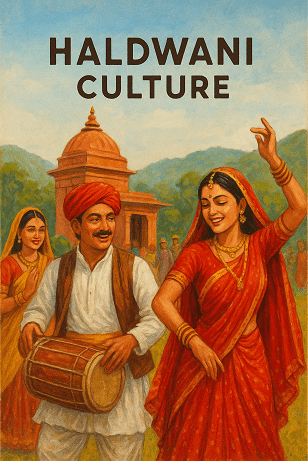
Haldwani Language
Haldwani Languages reflect the city’s cultural diversity, with Kumaoni and Hindi being the most widely spoken. Haldwani languages also include Garhwali and Urdu in some communities, while English is used in education and business. The blend of local dialects and modern communication makes Haldwani languages an important part of its heritage and identity, showcasing both tradition and progress in Uttarakhand’s “Gateway of Kumaon.
Traditional Clothing
Haldwani Traditional Clothing reflects the cultural heritage of Kumaon and nearby regions of Uttarakhand. For men, Haldwani traditional clothing often includes dhoti, kurta, and a traditional cap, while women wear ghagra, saree, or pichora, especially during festivals and weddings. The traditional clothing of Haldwani is rich in colors, patterns, and symbolic designs that showcase local identity and rituals. Today, Haldwani traditional clothing blends with modern attire, preserving cultural roots while adapting to contemporary fashion.
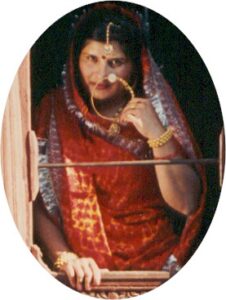
Rangwali Pichhora
Rangwali Pichhaura is a garment worn at ceremonial occasions in Uttarakhand. From bride to great grandmother, every women in the family wear it on occasions be it namkarna or marriage, upanayan or mundon. It has a special significance and mandatory for all married women in the family or close relation. Another salient feature of Rangwali Pichhora is that it can be put on by widows also, those as per social traditions, they are not supposed to wear colourful garments.
Style Of Building Houses/Materials used
Houses in Kumaon are traditionally built with an elevated living area where the inhabitants live and a shed on the ground level where the cattle is housed. Houses are made of stone, tin, mud and grass, with floors of wood or stone. Haldwani has seen rapid urbanization over the past two decades which has led to the growth of construction of buildings erected for commercial purposes. These are similar to buildings built in the metropolises with contemporary designs. Also the rise in the disposable income of locals has led to well known consumer barnds setting up shop in the town. Such showrooms are located in modern glass and stone buildings.
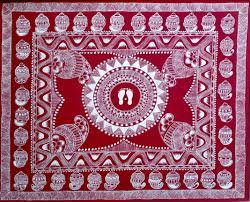
In Uttarakhand, aipan are popularly drawn at places of worship, houses, and main entry doors of house and in front courtyard. Some of these artistic creations have great religious importance and these are drawn during particular religious ceremonies or auspicious occasions such as marriages, Threading ceremony, naming ceremony etc. to perform rituals while others are for particular God / Goddess and a few for aesthetic look.
Traditional songs /Dances
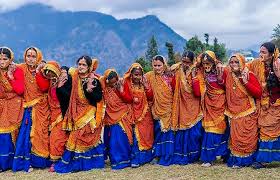
Similar to the rest of the Kumaon region ,musical instruments like the Hurka, Turturi and Dhol are played by the people of Haldwani. Dances like the Chholia Nritya, a traditional war dance with a sword and shield, the Jhora, a group dance and the Chhapeli are also predominant in this region. Folk songs are usually devotional and have heroic mythological themes. Love songs and songs with moral messages are also popular. Bhangra and giddha are also popular amongst the Sikh Community.
Traditional Way Of Life
Haldwani has always been an important transit and trading town. Trading in merchandise and goods has been a primary source of income for over a hundred years. Agriculture has also traditionally been and has remained to the present day ,an important means of livelihood in the town.
Art Forms of Aipan
Reasonably, Haldwani embraces and resembles the Art forms of Kumaon Hills. One of them is traditional Aipan. Be it mundane decoration of entrance staircase or Namkarna, Pooja or marriage, Satyanarayana Katha at Diwali, Aipan is a must and an integral part of Kumaoni culture.
Aipan is one of the traditional art (painting form) of Kumaon. It has great social, cultural and religious significance. Aipans are known by different names and is in popular in many parts of India with larger variations. It is called Alpana in Bengal, Sathiya, Rangoli and Chaakla in Gujarat, Rangoli in Maharashtra, Chowk pooran in UP, Kolam in south India, Madne in Rajasthan, Arichan in Bihar and Bhuggul in Andhra.
All Categories
Education
Event Services
Home Decor
Others
Shopping
Stay Finder
Utilities
>Astrologers>Authorized Centre>CA's & Lawyers>Construction Material Supplies>Financial Advisor>Freelancer>Insurance>On Demand Services>Bike/ Car on Rent>Electrician>Laundry & Dry Cleaners>Plumbers>Repair Services>Supplier>Taxi Services>Printing Press | Flex Printing Services>Services Provider>Spa & Salon>Tiffin Service>Transport Service